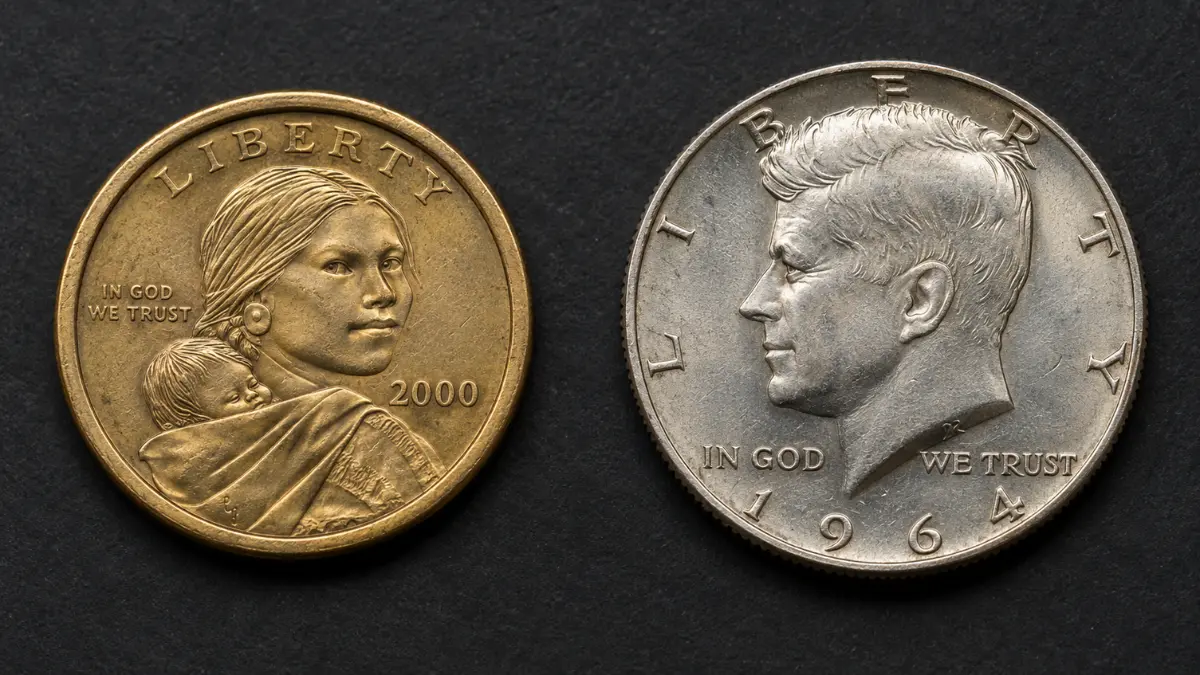
A gold-colored dollar and a silver-colored half dollar can tell very different stories—and their face values won’t tell you which deserves a closer look.
The Sacagawea dollar is worth $1 in spending money, while the Kennedy half dollar is worth 50 cents. For collectors, however, the important details are the date, metal, condition, and variety. The smaller-denomination coin may contain silver, while the golden-looking coin usually contains no gold.
There is also a significant 2026 update: the U.S. Mint’s half dollar features a temporary “Enduring Liberty” design for America’s 250th anniversary. Meanwhile, the 2026 Native American dollar retains Sacagawea’s portrait and honors the Oneida Tribe and Polly Cooper on its reverse.
Here’s how to identify the coins, understand their value, and avoid mistaking ordinary pocket change for a rare collectible.
Sacagawea Dollar vs Kennedy Half Dollar at a Glance
| Feature | Sacagawea dollar | Kennedy half dollar |
|---|---|---|
| Face value | $1 | $0.50 |
| First issued | 2000 | 1964 |
| Main portrait | Sacagawea carrying her infant son | President John F. Kennedy |
| Usual appearance | Golden color | Silver color |
| Diameter | 26.49 mm | 30.61 mm |
| Standard modern weight | 8.10 grams | 11.34 grams for copper-nickel clad issues |
| Regular composition | Copper core with manganese-brass outer layers | 90% silver in 1964; 40% silver in 1965–1970; copper-nickel clad from 1971 |
| Edge | Plain on original 2000–2008 issues; lettered on Native American dollars from 2009 | Reeded |
| Main collecting interests | Reverse designs, varieties, errors, condition | Silver content, dates, proofs, varieties, condition |
The Kennedy half dollar is physically larger, despite having half the face value. Special collector issues can have different compositions and weights from the standard coins described above.
The History Behind the Two Coins
Sacagawea dollar: a new look for the $1 coin
The U.S. Mint introduced the Sacagawea Golden Dollar in 2000. Its front shows Sacagawea carrying her son, Jean-Baptiste, while the original reverse features an eagle.
That original design ran from 2000 through 2008. In 2009, the Native American $1 Coin Program began, retaining Sacagawea’s portrait while introducing a different reverse each year to recognize Native American contributions to U.S. history.
This distinction helps when identifying a coin: a dollar with Sacagawea on the front and a different scene on the back may be a normal later issue.
Kennedy half dollar: a presidential memorial
The Kennedy half dollar debuted in 1964, following President John F. Kennedy’s assassination in November 1963. Gilroy Roberts designed the portrait, and Frank Gasparro designed the familiar reverse based on the presidential seal.
The series also includes Bicentennial coins dated 1776–1976, which show Independence Hall instead of the usual eagle reverse. Their different appearance is intentional; it does not automatically make them rare.
Does Either Coin Contain Gold or Silver?
Color alone cannot establish precious-metal content. This is one of the most useful distinctions for anyone checking inherited coins or a change jar.
Standard Sacagawea dollars contain no gold
The familiar golden color comes from manganese brass. The standard dollar’s overall composition is approximately:
- 88.5% copper
- 6% zinc
- 3.5% manganese
- 2% nickel
A normal golden dollar should therefore be evaluated as a collectible coin, rather than valued as gold bullion.
Early Kennedy half dollars contain silver
For regular Kennedy half dollars, check the date first:
| Date | Standard composition | Why it matters |
|---|---|---|
| 1964 | 90% silver | Precious-metal content contributes to value |
| 1965–1970 | 40% silver | Contains silver despite looking similar to later halves |
| 1971 onward | Copper-nickel clad | Regular issues contain no silver; collector exceptions exist |
The Mint’s historical records document the transition from 90% silver to 40% silver, followed by the removal of silver from regular half dollars in 1971.
Some later collector releases contain silver. An “S” mint mark or a shiny surface alone is not enough to establish the composition—identify the exact issue.
Sacagawea Dollar vs Kennedy Half Dollar Value in October 2026
The most useful starting point is to separate face value, metal value, and collector value.
Face value is the denomination. Metal value depends on composition and metal prices. Collector value depends on the specific coin, including its condition and whether it has an authenticated variety or error.
Practical value guide
| Coin category | How to approach its value |
|---|---|
| Common, circulated Sacagawea dollar | Start at its $1 face value; verify any claimed premium |
| Common, circulated copper-nickel Kennedy half | Start at its 50-cent face value; check the exact date and variety |
| 1964 Kennedy half | Evaluate silver content plus any collector premium |
| 1965–1970 Kennedy half | Evaluate its lower silver content plus any collector premium |
| Proof or exceptional uncirculated coin | Compare the exact issue, finish, and grade |
| Authenticated scarce variety or mint error | Use comparable completed sales and specialist attribution |
This is an identification guide, not a fixed October 2026 price list. Silver prices change, and two coins with the same date can sell for different amounts because of condition or variety.
For an individual valuation, compare recent completed sales for the same date, mint mark, variety, and grade. PCGS provides separate price-guide categories for Sacagawea dollars and Kennedy half dollars; an exceptional certified coin should not be used to price an ordinary circulated example.
Sacagawea Dollars Worth a Closer Look
The date 2000-P is a starting point for checking certain varieties, but that date and mint mark alone do not establish rarity.
2000-P Cheerios dollar
The best-known example is the Cheerios dollar, associated with a cereal promotion. Its important identifying feature is enhanced detail in the eagle’s tail feathers.
PCGS records a $34,500 auction result for an MS68 example in July 2008. That is a historical sale of a specific high-grade coin—not a current value for every 2000-P dollar.
2000-P Wounded Eagle variety
PCGS also recognizes the 2000-P Wounded Eagle variety. If you suspect your coin matches it, compare the actual diagnostic features with a specialist reference. A mark that looks unusual still needs identification before it supports a premium.
The useful question is: “Does my coin match a documented variety?”
Kennedy Half Dollars Collectors Often Check
Several Kennedy issues attract attention beyond ordinary circulated clad coins:
- 1964 Accented Hair proofs: a recognized proof variety.
- 1970-D: an issue collectors commonly check when building a date-and-mint set.
- 1998-S matte-finish half dollars: a distinctive collector issue.
- Documented doubled-die and No FG varieties: attribution depends on the specific date and diagnostic features.
A coin’s condition matters alongside its identity. Wear, scratches, cleaning, and other surface problems can make an apparently similar example a poor comparison with a premium auction coin.
What Changed in 2026?
Two developments deserve attention in an October 2026 comparison.
The 2026 half dollar has a different design
The U.S. Mint’s 2026 half dollar uses the Enduring Liberty design. Its front presents a close-up of the Statue of Liberty, while the reverse depicts Liberty passing her torch to a new generation.
A 2026 half dollar without Kennedy’s portrait is therefore an intentional anniversary design.
The 2026 Native American dollar honors Polly Cooper
The 2026 Native American dollar keeps Sacagawea and her infant son on the front. Its reverse honors Polly Cooper and the Oneida Tribe’s assistance to the Continental Army at Valley Forge.
That makes it a relevant addition for collectors following the annual reverse designs, although a new design alone does not establish future rarity.
How to Check Your Coin Before Selling It
Use this simple inspection process:
- Record the date and mint mark. On Native American dollars from 2009 onward, inspect the edge for this information.
- Identify the composition. For Kennedy halves, separate 1964 and 1965–1970 examples from ordinary later clad coins.
- Photograph both sides and the edge. Use clear lighting and close-ups of any suspected variety.
- Compare matching completed sales. Match the issue and condition as closely as possible.
- Seek specialist identification when justified. A valuable-looking feature should be confirmed before paying for grading.
Keep the coin in its existing condition during identification. Polishing it to make it look newer can complicate its evaluation.
Which Coin Should a Beginner Collect?
For a compact collection centered on changing artwork, Sacagawea and Native American dollars offer a clear theme. A collector can follow the original eagle design and then explore the annual Native American reverses.
For a collection centered on changing metal compositions and presidential history, Kennedy half dollars offer several distinct collecting paths. A small starter group could include a 1964 silver coin, a 1965–1970 silver-clad coin, and a later copper-nickel example.
Choose the series whose history interests you enough to learn its details. Recognizing an ordinary coin accurately is the foundation for recognizing an unusual one.
Frequently Asked Questions
Is a Sacagawea dollar worth more than a Kennedy half dollar?
Its face value is higher: $1 versus 50 cents. Collector value depends on the individual coins. Silver content or a scarce authenticated variety can change the comparison.
Are all 2000 Sacagawea dollars rare?
No. The date alone does not identify a scarce variety. Features such as the Cheerios reverse must be checked separately.
Is a Sacagawea dollar with no date on the front an error?
Not necessarily. Native American dollars place the year and mint mark on the edge, so inspect the edge before assuming the date is missing.
Does a silver-colored Kennedy half dollar contain silver?
The color is not enough. Regular 1964 examples contain 90% silver, and regular 1965–1970 examples contain 40%. Most later regular issues are copper-nickel clad.
What should I check first?
Check the date, then the mint mark, composition, and condition. Those details give you a much stronger starting point than a dramatic price attached to a similar-looking coin online.


Emily Carter is a finance writer specializing in personal finance, budgeting, saving strategies, and financial planning. She simplifies complex financial topics into clear, practical insights to help readers make informed money decisions.