
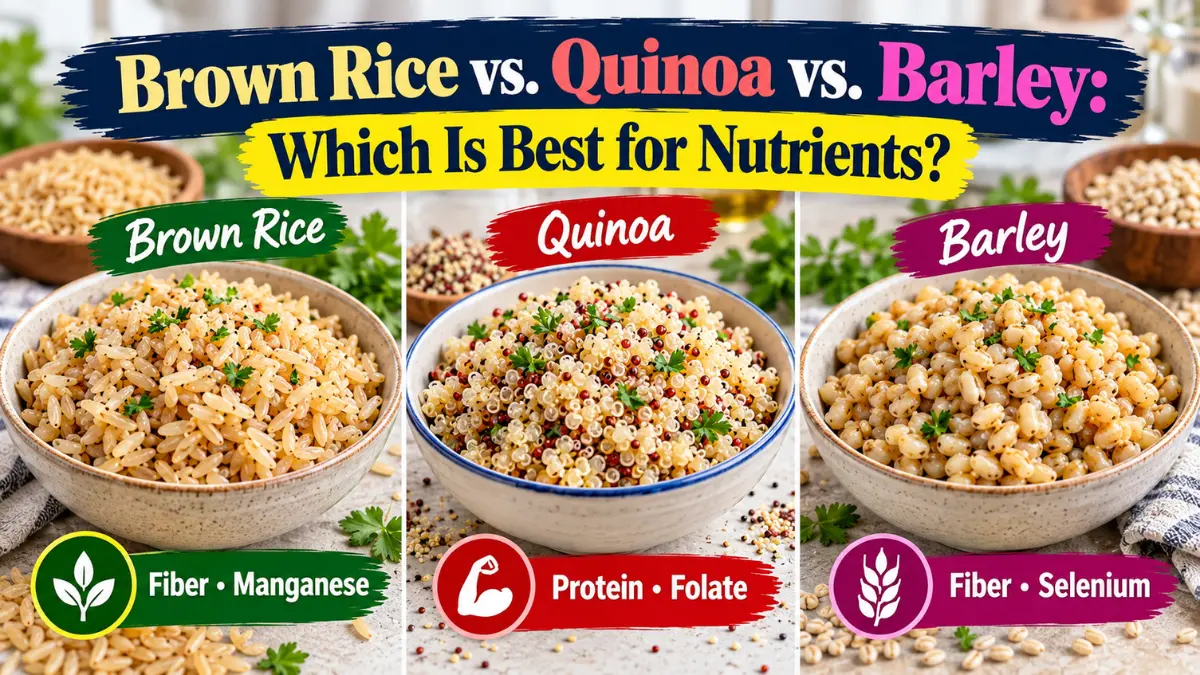
Brown rice, quinoa, and barley all sit in the “healthy whole grain” category, but they aren’t interchangeable. Each one stands out for a different set of nutrients, so the best choice depends on what you want more of: protein and minerals, fiber for digestion, or a mild, budget-friendly staple. Here’s how they compare, using standard USDA-based figures for cooked grains per 100 grams.
Quinoa is the richest in protein, magnesium, and folate
Quinoa is the nutritional heavyweight of the three. It provides about 4.4 grams of protein per 100 grams cooked, compared with 2.7 grams in brown rice and 2.3 grams in barley. It’s also the highest in magnesium at roughly 64 mg and in folate at about 42 µg, and it contains all nine essential amino acids, which is unusual for a plant food. The trade-off is price and flavor: quinoa usually costs more than the other two, and some people find its natural coating (saponin) bitter unless it’s rinsed well.
Barley leads on fiber
Pearled barley has about 3.8 grams of fiber per 100 grams cooked, ahead of quinoa at 2.8 grams and brown rice at 1.6 grams. Much of that is beta-glucan, a soluble fiber studied for its role in cholesterol and blood sugar control. Barley also has a pleasantly chewy texture that works well in soups and stews. The downside is that it contains gluten, so it’s not suitable for anyone with celiac disease or gluten sensitivity.
| Nutrient (per 100g cooked) | Brown Rice | Quinoa | Barley (pearled) |
|---|---|---|---|
| Calories | ~123 | ~120 | ~123 |
| Protein | ~2.7 g | ~4.4 g | ~2.3 g |
| Fiber | ~1.6 g | ~2.8 g | ~3.8 g |
| Magnesium | ~39 mg | ~64 mg | ~22 mg |
| Folate | ~4 µg | ~42 µg | ~16 µg |
| Standout benefit | Gentle flavor, gluten-free, budget-friendly | Complete protein, magnesium, folate | Beta-glucan fiber, chewy texture |
Brown rice is the simplest, most versatile option
Brown rice doesn’t top the chart for any single nutrient, but it’s a reliable all-rounder. It’s naturally gluten-free, widely available, and the cheapest of the three. It supplies steady energy and decent manganese and selenium, and its mild taste pairs with almost anything. The trade-off is lower fiber and protein than the other two, so it works best alongside beans, vegetables, or fish rather than on its own.
How to build a more nutritious bowl from all three
You don’t have to pick just one. A few ideas for getting the best of each:
- Mix cooked quinoa and brown rice half and half for more protein with a familiar texture
- Add barley to vegetable soups for fiber and a heartier bite
- Pair any grain with beans or lentils to boost protein and keep you full longer
- Rinse quinoa before cooking to remove bitterness
- Cook a big batch once and refrigerate it in portions for easy weekday meals
So which grain is best for nutrients?
If you want the broadest nutrient boost, quinoa wins on protein, magnesium, and folate. If digestive health and fiber are your priority, barley is the clear pick. If you want an affordable, gluten-free, easy staple, brown rice is the best bet. The smartest move is to rotate them, or blend them in one dish, since each fills a different nutritional gap.
FAQs
Q: Which grain has the most fiber, brown rice, quinoa, or barley?
Barley has the most, at about 3.8 grams per 100 grams cooked, compared with roughly 2.8 grams in quinoa and 1.6 grams in brown rice.
Q: Which is best for weight loss?
All three have similar calories, so fiber and fullness matter most. Barley’s fiber and quinoa’s protein both help you feel satisfied, and portion size does the rest.
Q: Is quinoa really a complete protein?
Yes. Quinoa contains all nine essential amino acids, though the amounts of some, like lysine, are modest compared with animal proteins.
Q: Are these grains gluten-free?
Brown rice and quinoa are naturally gluten-free. Barley contains gluten, so avoid it if you have celiac disease or gluten sensitivity.
This article is for general information and isn’t a substitute for medical advice. If you have a medical condition affecting your diet, check with your doctor or dietitian.
Jessica is a passionate food content writer who loves exploring delicious recipes, culinary trends, and cooking tips. She creates engaging, easy-to-follow content that inspires readers to discover new flavors and enjoy the art of cooking.